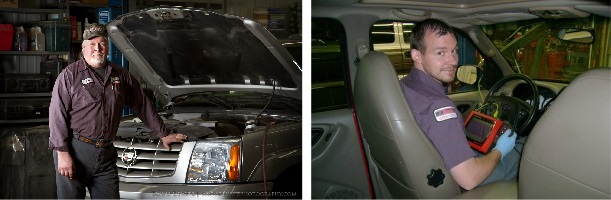

This case study is on a 1995 Chrysler Town and Country Minivan with a 3.8 liter. This van came into the shop with the complaint that it was misfiring, bucking, backfiring, and just plain ran terrible when driven. I drove the van and they were correct. It was like the timing was off the way it was popping up thru the intake and misfiring. The van started and ran fine at idle and didn't start running rough until you were over 2000 rpm. Maybe worn timing chain, plugged exhaust, fuel supply issue? I wasn't sure so I continued with my diagnoses. My Snap-on Modis scanner reveled a coil driver code, so I went out and checked the coil driver circuit, plugs and wires, and coil itself. Everything look good besides that I was losing spark intermittently from the coil pack above 2000 rpm. I than proceeded to check the cam and crank signals. T&C_Case_Study_1


The cam signal didn't have a nice square wave (see images) so I started tracing that problem down. I thought that the cam sensor was failing causing the problem. With pure luck during my testing I happened to switch my test leads between the sensors and to my surprise the crank signal now had the glitch. The glitch was caused by my failing channel 2 in the scope module. Marc Hagel, my Snap-on dealer, was happy to take care of my problem by replacing the my Modis' scope module.

As I analyzed the cam and crank I noticed the pattern switched good, dropped all the way to 0 volts and up to 5 volts, the cam and crank had the proper alignment, and stayed true even above 2000 rpm. The one thing I did notice was the crank went from 5 volts to 0 while the cam was going from 0 volts to 5 volts. Was this normal? I knew the 3.0 liter and 3.3 liter engines that the cam and crank signals both went from 0 volts to 5 volts, so I searched iATN waveform library, my manuals, and my scope patterns and nowhere could I find any cam and crank signal from a 3.8. Maybe the 3.8 was suppose to have this type of signal. Besides everything else in the scope pattern being correct and the engine starting and running I figured the engineers thought this would be something new they would try, just like every other mess they sometimes make. Anyway's how would a hall effect sensor even be able to flip its signal with out effecting anything else.T&C_Case_Study_2


So I went on checking everything on this monster that I could. I was completely lost and had nowhere else to go but back to the beginning. I could just throw parts into this minivan and see what it takes to fix it, but that is not the way I work. When you know how everything is suppose to work, how to use your tools, how to get the information you don't have, you should be able to know the exact cause of the problem before you buy anything to fix it. This is how 90% of my diagnose jobs go. The other 10% you have to use process of elimination to find the defective part, like with some computer and module problems.

Anyway's, the only thing on this van that seemed out of place was this crank signal pattern. I just couldn't see how this van would start and run good up to 2000 rpm if this wasn't the pattern the PCM was expecting. So I pulled the sensor out of the bell housing, looked it over for any problem and reinstalled it. WALA!! The crank signal now went from 0 volts to 5 volts instead of 5 volt to 0 volts. To this day I do not know how this hall effect sensor did this and nor does any other knowledgeable persons I have talk with. Maybe cracked magnet, magnetic field, internal corrosion? This van got a new crank sensor and was on it's way.

© 2006 Dewitz Truck & Auto Repair, LLC. Site designed and maintained by Travis Dewitz. All rights reserved.
Case_Studies_Home
Case_Study_Master